
How to Calculate the Production Capacity of a Rigid Box Manufacturing Line
Multiply actual line speed by effective running time and the share of units that pass final inspection to estimate how many good boxes a rigid box line can make.
What Counts as Production Capacity in Rigid Box Manufacturing?
Production capacity is the number of units a line can deliver in a given hour, shift or day under defined operating conditions. Count units at the point where they’re ready for the next operation or shipment. If the line ends at case making, count accepted cases. If it includes box assembly, count accepted finished boxes.
How Do You Calculate Rigid Box Line Output per Hour?
Use the average speed recorded at the line’s final stage while it is running, counting both good and rejected units. For output per scheduled hour, use the actual running minutes within that hour.
Accepted output = Actual line speed (units/min) × Effective running time (min) × Final pass rate
Calculation example: A line averages 24 boxes per running minute, runs for 50 minutes in a scheduled hour and has a 98% final pass rate. Its estimated output is 24 × 50 × 0.98 = 1,176 accepted boxes per scheduled hour. These figures are illustrative.
What Is the Difference Between Rated Speed and Actual Output?
Rated speed is a specification for a particular machine and configuration. Actual output reflects the job being run, the time the line spends producing and the number of units that pass inspection. If you already measure accepted units per scheduled hour at the end of the line, that figure already includes the effect of stops and rejects. Applying those losses again would understate output.
How Do Bottlenecks Limit Rigid Box Line Capacity?
The line’s sustainable output is limited by the stage or transfer step with the lowest effective capacity. Compare stages on the same time basis and convert their output to equivalent finished units. A queue that keeps building before one station, or a downstream station that frequently waits for material, can help identify where to investigate.
How Do Changeovers and Downtime Affect Shift Output?
Subtract time when the line stops producing from scheduled shift time. This can include format changes, cleaning, material shortages and unplanned stops. If slower running is already included in your measured speed, or setup rejects are already included in your pass rate, avoid deducting those losses again.
For a shift with several products, estimate accepted output for each run using its own speed, running time and pass rate, then add the results.
How Do You Balance Case Making and Inner Lining Capacity?
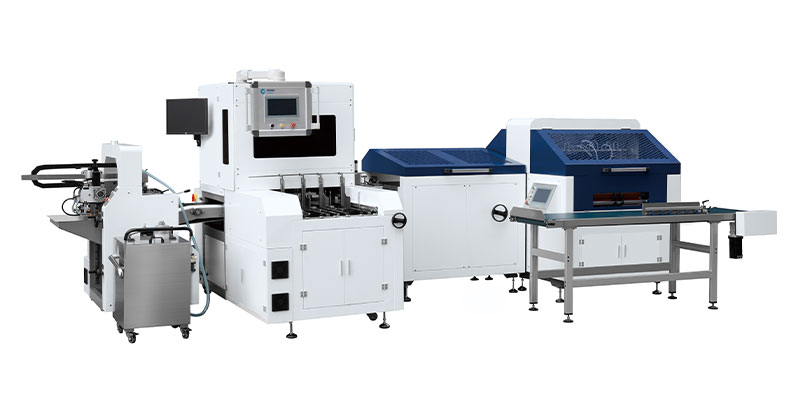
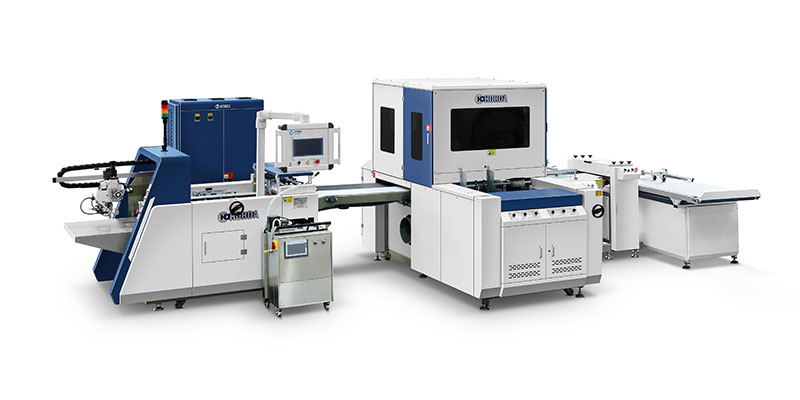
When comparing rigid box making machines and production lines, check case making and inner lining using the same case design and materials. Compare how many usable cases the case maker can supply with how many cases the lining stage can process over the same period.
If the lining stage can handle fewer cases per hour than the case maker supplies, excess cases will accumulate between stages. A buffer can absorb short interruptions, but it cannot close a sustained capacity gap. For production planning, use the accepted output at the end of the line across a representative shift, including normal product changes.