
Foldable Rigid Boxes: Market Trends and Opportunities
The global packaging industry continues to expand, supported by consumer goods, e-commerce, premium retail and increasingly complex supply chains. Within this growing market, foldable rigid boxes are emerging as a promising packaging format, combining the premium presentation of traditional rigid boxes with the storage and transportation advantages of flat-pack packaging.
As conventional packaging categories become more competitive, manufacturers are looking beyond standard box designs for products that offer greater value. Foldable rigid boxes present an opportunity to enter differentiated packaging applications, improve logistics efficiency and develop new revenue streams.
Global Packaging Market Outlook
The global packaging industry remains a substantial and growing market. According to Smithers' industry research, the global packaging market was valued at approximately USD 1.2 trillion in 2025 and is projected to grow at a compound annual growth rate (CAGR) of 3.5% through 2030.
Growth is supported by demand across food and beverages, personal care, healthcare, consumer electronics and other packaged goods. The development of e-commerce and international distribution also continues to influence packaging specifications, particularly in protection, material selection, warehousing and transportation.
China and the United States illustrate the scale of these distribution channels. In 2025, China's online retail sales of physical goods reached approximately RMB 13.09 trillion, an increase of 5.2% year over year. In the second quarter of 2026, U.S. retail e-commerce sales reached approximately USD 340.2 billion on a seasonally adjusted basis, up 12.2% from the same quarter of 2025.
These developments reinforce the importance of packaging throughout the supply chain. However, market growth does not necessarily translate into higher margins for every packaging supplier. Standardized packaging products are widely available, and manufacturers increasingly compete on price, delivery, finishing quality and production capability.
As a result, structural innovation is becoming an important route to product differentiation. Packaging formats that address multiple commercial requirements can create opportunities beyond conventional box manufacturing.
Rigid Box Market Growth
Rigid boxes occupy an established position in the packaging industry, serving applications that require structural protection, presentation quality and a premium appearance. They are used across cosmetics, electronics, gift packaging, specialty retail and other consumer-product categories.
The global rigid box market reached an estimated USD 65.44 billion in 2025. Fortune Business Insights forecasts the market to reach USD 68.34 billion in 2026 and USD 100.35 billion by 2034, representing a CAGR of approximately 4.92% during 2026–2034.
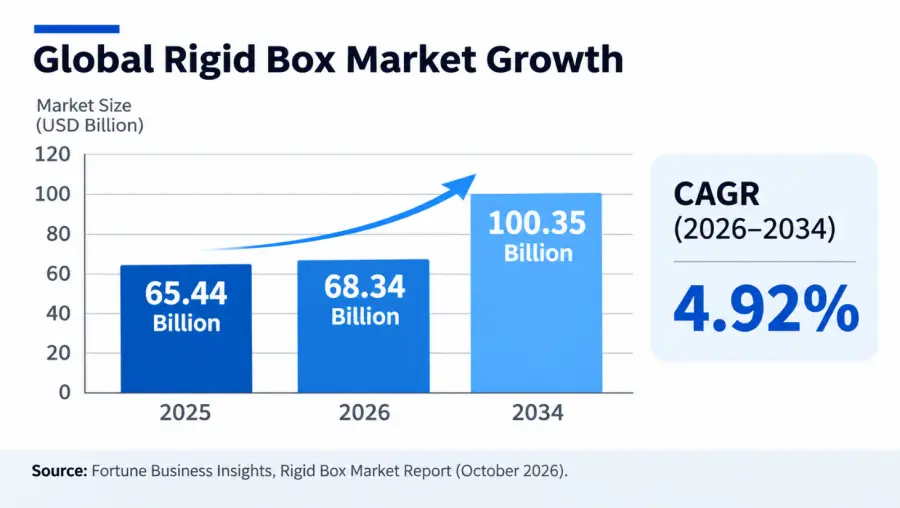
North America accounted for 33.21% of the global rigid box market in 2025, making it the largest regional market. Asia-Pacific ranked second, with a market value of USD 18.61 billion. Demand across both regions is supported by applications in personal care, food and beverages, electronics, and branded consumer goods.
Within premium paperboard packaging, traditional rigid gift boxes remain valued for their substantial construction, finished edges and decorative possibilities. Yet many of these products have become familiar offerings among established packaging manufacturers.
Competing only through different covering papers, printing treatments or similar box structures can make it difficult to establish a distinctive position. For manufacturers seeking additional growth, the more attractive opportunity may lie in developing packaging formats that offer new functional value.
Foldable rigid boxes are one such direction. Rather than competing exclusively on appearance, they introduce a structural advantage that can influence transportation, storage and the way packaging is supplied to customers.
The Rise of Foldable Rigid Boxes
Foldable rigid boxes, also known as collapsible rigid boxes, are rigid paperboard packages designed to be flattened for storage and transportation and assembled into their finished shape when required.
Unlike conventional pre-assembled rigid gift boxes, foldable structures use multiple rigid board panels with controlled folding joints. Depending on the design, triangular corner wings, connecting panels and suitable closure mechanisms allow the box to transition between flat and three-dimensional states.
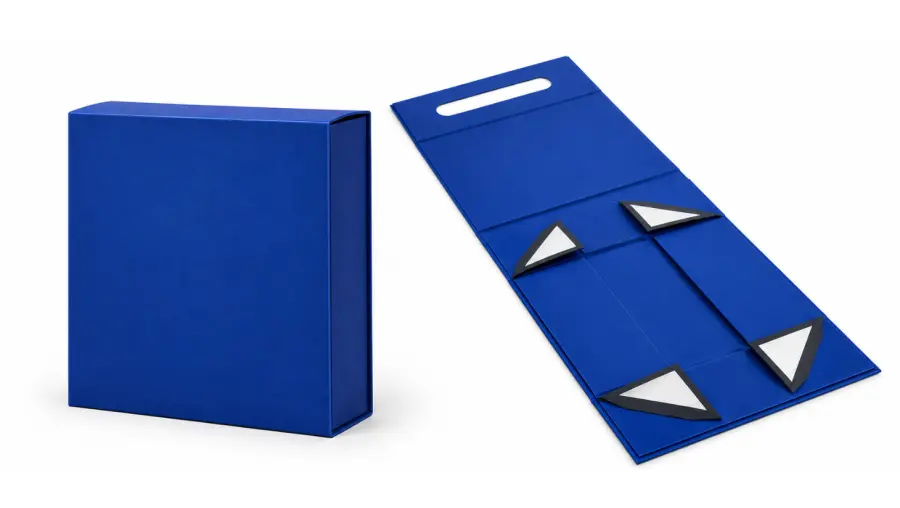
The design combines characteristics of premium rigid packaging with the logistics flexibility traditionally associated with flat-packed cartons.
When assembled, the box can provide the appearance and presentation expected from premium gift packaging. When flattened, it occupies less space than a comparable box that must retain its finished shape throughout transportation and storage.
This distinction gives packaging manufacturers an additional product category that can serve requirements not always satisfied by conventional folding cartons or assembled rigid boxes.
For brands, the value lies in balancing appearance with supply-chain efficiency. For packaging converters, it creates opportunities in structural design, specialized production and customized packaging projects.
Structural and Logistics Advantages
The principal commercial advantage of foldable rigid boxes is the ability to reduce the volume occupied by empty packaging. This becomes particularly important when packaging is manufactured in one location and transported to another facility for product filling, assembly or distribution.
Transportation Efficiency
Traditional rigid boxes often occupy their full assembled volume during shipping. Foldable rigid boxes can be packed in a flat configuration, allowing more empty packages to be transported within the same available space.
In a documented collapsible rigid box packaging project, a standard 40-foot container accommodated approximately 1,920 conventional rigid boxes, compared with approximately 9,000 collapsible rigid boxes of the corresponding design.
This represented approximately 4.7 times the loading capacity for that particular packaging project.
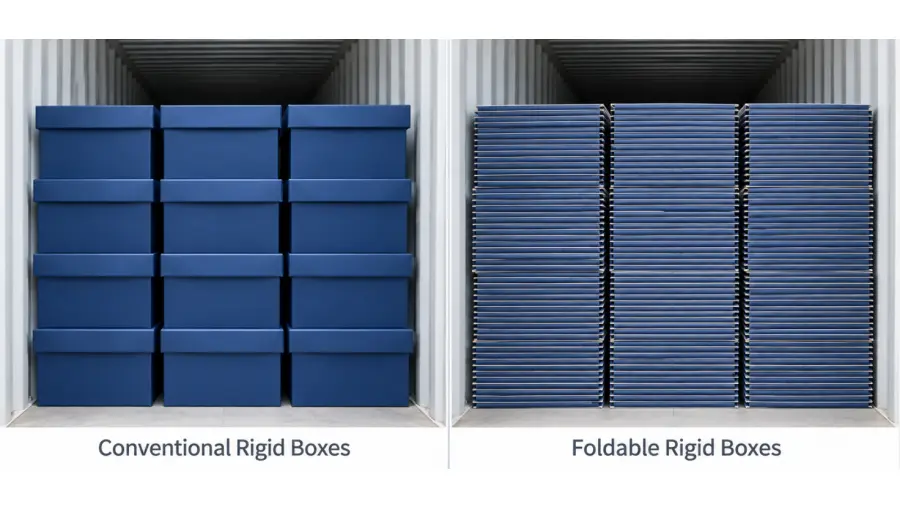
For packaging suppliers handling international orders, higher empty-box loading density can reduce the transport space allocated to each unit. The potential benefit becomes more significant in projects involving large quantities, repeated shipments or overseas packaging procurement.
Warehouse and Inventory Management
Foldable structures also allow empty rigid boxes to be stored in compact stacks until required for final packing.
This can be particularly useful for seasonal gift collections, promotional packaging and product launches where substantial packaging inventory may be prepared ahead of distribution.
More compact stockholding may help reduce warehouse space requirements and improve inventory flexibility.
Premium Presentation
Logistics efficiency would have limited value if the finished package failed to meet the customer's presentation requirements. The appeal of foldable rigid boxes lies in preserving a premium appearance after assembly.
Rigid board construction, wrapped surfaces, printed finishes and customized closure designs can be incorporated into suitable folding structures. This allows the packaging to maintain its visual and tactile qualities while offering additional convenience before use.
The final benefit depends on the actual design, including assembly time, structural strength, materials and the condition of the finished box. A well-developed structure must deliver both presentation quality and practical handling performance.
Key Application Markets
Foldable rigid boxes have particular potential in packaging applications where premium presentation and the logistics of empty boxes are both important.
Cosmetics and Personal Care
Cosmetics, fragrance collections and beauty gift sets frequently use rigid packaging to strengthen product presentation. Foldable rigid boxes can provide an alternative for brands seeking attractive gift packaging with more efficient empty-box transportation and storage.
Luxury Gifts and Promotional Packaging
Corporate gifts, holiday collections and promotional products often require customized packaging in large quantities. Foldable structures can support advance production and compact storage before final assembly, making them relevant to seasonal and international gift programmes.
Consumer Electronics
Premium electronic accessories and selected consumer devices use presentation packaging to communicate product value. Foldable rigid boxes may suit products where the structure can accommodate protective inserts and maintain the necessary strength after assembly.
Fashion and Lifestyle Products
Branded accessories, apparel gift sets and lifestyle products offer opportunities for customized foldable rigid packaging. The ability to combine a recognizable finished box with flat-pack supply can be useful for brands operating across different stores, warehouses and markets.
The strongest opportunities are found in applications where the packaging structure provides a measurable advantage. Product weight, assembly requirements and protective performance should be considered alongside visual design.
Regional Market Opportunities
China and Asia-Pacific
China's established packaging manufacturing industry provides a strong foundation for the development of foldable rigid boxes. Many manufacturers already have experience in greyboard processing, paper covering, printing and customized gift packaging.
Adding foldable structures can help these companies extend their product portfolios and approach customers with requirements beyond conventional rigid boxes.
Export-oriented packaging projects are particularly relevant. Empty boxes manufactured in China may be shipped to overseas product-packing facilities, where transportation density and storage efficiency can influence the total procurement cost.
Across other Asia-Pacific markets, premium gifting, cosmetics, electronics accessories and branded merchandise provide additional areas for product development.
North America
North America remains an important market for rigid packaging, supported by established consumer brands, retail distribution and premium product categories.
For companies purchasing packaging from international suppliers, foldable rigid boxes can offer an alternative where empty-box freight, warehousing and local assembly are important cost considerations.
Packaging manufacturers entering this market should be prepared to demonstrate reliable structures, consistent appearance and realistic cost benefits under the customer's distribution conditions.
Europe
European packaging markets are increasingly influenced by material efficiency, recyclability and packaging waste requirements.
The EU Packaging and Packaging Waste Regulation (PPWR), which began applying in August 2026, is shaping the direction of packaging design and material selection.
Foldable structures can contribute to more efficient empty-box transportation and storage. However, the overall environmental performance also depends on the use of paperboard, adhesives, coatings, magnets and other components.
For suppliers targeting Europe, structural efficiency should be developed together with appropriate material specifications and compliance requirements.
Manufacturing and Market Entry
For packaging manufacturers, entering the foldable rigid box segment requires more than introducing a new product sample. Commercial success depends on selecting suitable applications, developing reliable structures and building repeatable production capabilities.
Product Development
Manufacturers can begin with a focused range of commonly requested sizes and folding structures, such as premium gift boxes with triangular corner wings and attached covers.
Structural development should consider board thickness, folding clearance, assembly sequence, closure performance and the finished appearance.
Testing a limited number of practical designs before expanding customization can help reduce development complexity and improve repeat-order consistency.
Cost and Supply-Chain Evaluation
The selling price of a foldable rigid box should not be evaluated independently from its transportation and handling costs.
A complete cost assessment includes raw materials, production, surface finishing, protective packaging, freight, warehouse requirements and final assembly.
Some foldable designs may require additional processing or assembly costs. Their commercial value comes from achieving a favorable overall balance between manufacturing expense, logistics efficiency and finished-box quality.
Production Automation
Consistent manufacturing is essential for collapsible rigid structures. Multi-board positioning, spacing between connected panels, adhesive application and folding-wing preparation all influence whether the box can be assembled smoothly and maintain its intended shape.
For manufacturers preparing to develop this product category at scale, suitable automation can support production consistency and reduce dependence on manual positioning for selected processes.
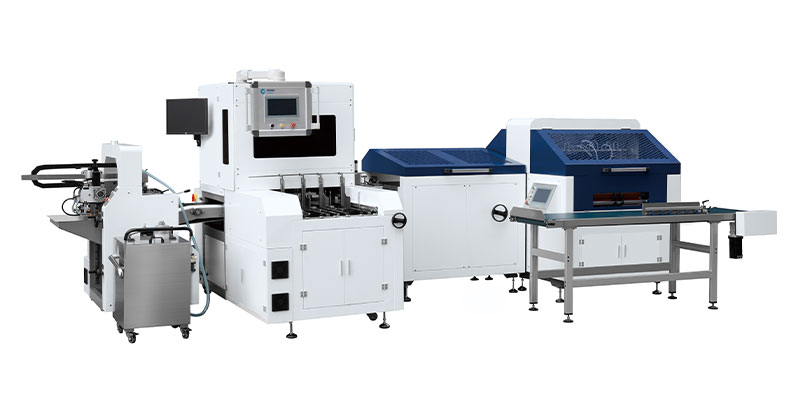
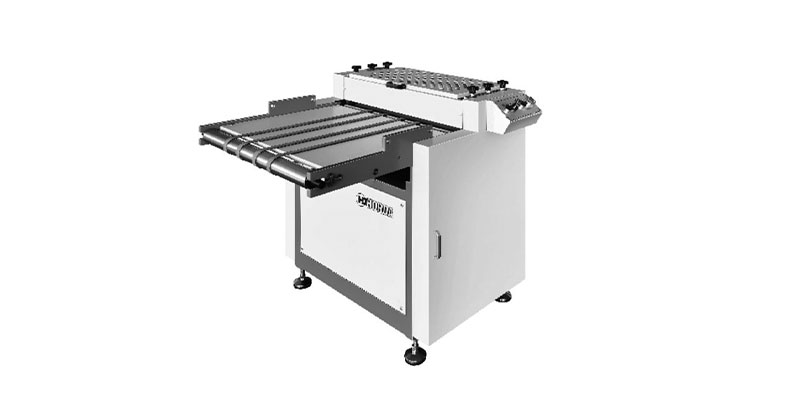
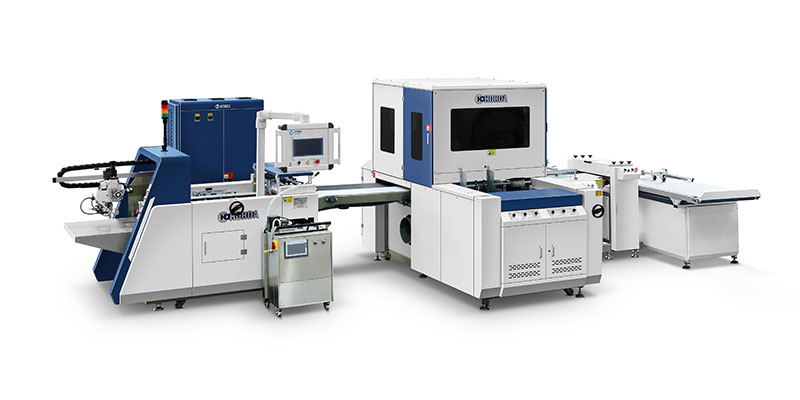
HORDA's foldable rigid box making machine range is designed for relevant processes including board positioning, gluing, wing forming and folding. Equipment configuration should be selected according to box structure, material requirements, size range and production demand.
Market Development
An effective market entry strategy begins with customers who already purchase premium rigid boxes and have clear requirements for shipping efficiency, inventory management or customized structures.
Manufacturers can prepare representative samples, compare flat-pack and assembled dimensions, evaluate production costs and demonstrate the final assembly process.
Building expertise in structural development and repeatable manufacturing creates a foundation for expanding into additional applications as customer demand develops.
Rather than relying only on price competition in established packaging categories, suppliers can position foldable rigid boxes as a specialized packaging option with both presentation and operational value.
Future Outlook
The global packaging industry is expected to maintain steady growth, with demand continuing across consumer goods, premium retail and international distribution. Rigid packaging will remain an important part of this market, while competition is likely to encourage further development in materials, structures and manufacturing processes.
Foldable rigid boxes offer a distinctive opportunity within this environment. Their ability to combine premium presentation with flat-pack transportation responds to practical requirements that conventional rigid boxes do not always address as efficiently.
Future development will depend on improving folding structures, optimizing materials, simplifying assembly and achieving consistent production quality. These improvements can expand the range of suitable applications and strengthen the commercial value of collapsible packaging.
For packaging manufacturers, the opportunity is to develop differentiated products before competing solely on price in established categories. By combining structural innovation, application knowledge and suitable production equipment, companies can position themselves to capture emerging demand for foldable rigid packaging.
Foldable rigid boxes are not a replacement for every conventional package. They represent a new direction in premium packaging, where structural design can create value in both the finished product and the supply chain.
PREV: What Is a Rigid Box?